
The '90s runner · plays offline
OONT
ऊँट · the rhythm runnerLast Beat · only those who keep time surviveThe dead are the Besura — the out-of-tune — and they walk in on the rhythm. Strike on their note and they're cured: they join your parade and play along. Miss, and they grab you. Keep time to heal.
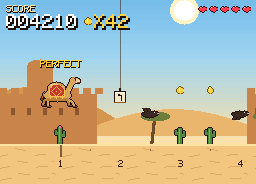
A camel called Oont runs through the world's grooves. The music is the level: every cactus is a stroke you jump, every bird a high stroke you duck, every hanging sign a rest — keep your feet down. Jump on time and your hooves play the drum.
Which run
Who is playing
Take turns: in Eyes you swap each time the camel is caught; in the campaign each of you runs every level. Best score wins.
Open a room and send its word. Everyone runs the same level — the same seed — at the same moment, on their own phone.
Got a word from a friend?
How you play
More options
World (for a room or a shared phone)
Night (for a room or a shared phone)
The horde (Last Beat)
Campaign
Your timing
If you are sure you're on the beat but Oont says "late", slide left. Bluetooth headphones usually want −60 to −120.
How the track makes music
The level is the rhythm
Every level is a groove at a tempo in a metre, and its obstacles sit exactly on the strokes. A cactus (or a conga, a surdo, a barrel) is a low stroke: jump on it. A bird is a high stroke: duck. A hanging sign with a rest painted on it is a written rest: keep your feet on the ground. Your hooves are the drum — jump on time and the stroke sounds.
Written out as you run
In Eyes & ears the bar you're running is written on a one-line percussion stave above the track: low strokes below the line (jump), high strokes above it (duck), accents marked >, rests as rests, triplets bracketed only where the maths needs them. Beat numbers are painted on the ground; a lamp flashes on every beat. Before each level you can hear the bar; after it, see it written with ▶ Play.
From one beat to 11/8
The campaign climbs Rhythm Arithmetic's ladder — a beat cut in two, then in four, then in three; one beat, two beats, a bar, two bars — then the metres: 2/4, 3/4, 4/4, 2/2, 6/8, 9/8, 12/8, 5/4, 7/8 (2+2+3 and 3+2+2), 9/8 as 2+2+2+3, 11/8, and the taals.
Ears, in the dark
Four nights: eighths; sixteenths and rests; triplets, swing and compound time; odd metres, clave and tihai. Each bar is played to you first; then the lamps go out and you run it from memory and ear. At dusk you glimpse the track at the last moment; at night you see nothing at all.
Eight worlds, and a boss in each
- Thar Desert — the dholak: eighths in 2/4, keherwa (8), dadra (6/8); boss Aandhi the sandstorm dances the bhangra chaal.
- Havana — the conga's tumbao, the cascara, son clave 3-2 and 2-3 in cut time; the rooster Don Gallo sings rumba clave.
- Rio — the surdo leaning on 2, sixteenths on the tamborim, bossa nova, baião; the carnival dragon calls samba cells.
- New Orleans — the swing ride, the shuffle, the second line, 12/8 blues; the Riverboat swings in 3/4.
- London · New York — rock, Motown, disco, sixteenth-note funk, 5/4 as 3+3+2+2; the Night Bus goes from boom bap to drum & bass.
- Lagos · Accra — the 12/8 bell (seven strokes in twelve), highlife, every ÷3 cell in 6/8, afrobeat; Ìyá Ìlù, the talking drum.
- The Balkans — rachenitsa 7/8 (2+2+3), lesnoto (3+2+2), karşılama 9/8 (2+2+2+3), nine two ways; the dragon Zmey in 11/8.
- The Temple — rupak (X 2 3), jhaptaal, ektaal, teentaal: bayan bols are jumps, dayan bols ducks; Gajaraja ends on a tihai that lands on sam.
Last Beat — the survival run
Only those who keep time survive
The dead are the Besura — the out-of-tune. They lurch off the beat and groan flat. A groove plays, and every wave of them is written as a bar: where they stand is the rhythm. Each wave is groaned to you one bar ahead, then it arrives. Strike on its note (the right half, or Space) and the Besura is cured — a villager again, who joins your parade and plays the next instrument of the band. Sour notes thrown above the line are blocked with the cymbal shield (the left half, or ↓) — in rock they come on the backbeat, 2 and 4.
Weapons are rhythmic values
The clap and the dhol mallet play only the beat (the mallet is a big hit that fells a Brute, an accented note). Drumsticks play the beat in two — eighths. Shakers play it in three — triplets, swing, 6/8 and 12/8. The snare roll plays it in four — sixteenths. The conch plays sam: blown exactly on beat 1 of the cycle it cures every Besura on the screen. Strike out of time — or on a written rest — and it's noise: your weapon wears, and the noise draws another Besura into the next wave. Tap a weapon at the bottom of the screen, or press 1–6 (C for the conch, E to cycle).
Healing is keeping time
At a campfire and at each chapter's safe house the heartbeat plays one bar; then it goes quiet and you keep it alone for a bar. The steadier your taps — near each beat, evenly spaced — the more you heal. Food floats on the off-beats a wave leaves empty: grab it exactly on its subdivision for its full value.
Five chapters, a boss in each
The Dhaba at Dusk (keherwa, eighths) · Broken Record Street (rock, sixteenths and rests) · Carnival of Crossed Rhythms (son clave 3-2 and 2-3) · The Bell Market (the 12/8 bell and swing) · The Temple of Sam (7/8 as 2 + 2 + 3, then teentaal and a tihai — blow the conch on the last beat). Choose Oont, Meera the drummer, Uncle Sitar or DJ Zo, as a Runner, a Tank or a Medic. Listen: a Besura on the beat groans a low G; on the & a D; on a triplet a B-flat; on a sixteenth an F.
Controls
Keyboard: Space or ↑ to jump (hold for a higher jump in Eyes), ↓ to duck, P to pause. Phone and tablet: the screen is two big halves — tap the right half to jump, hold the left half to duck. Coins, hearts (a life), golden bells (a shield) and double-coins ride on the strokes: play the stroke on time to collect them. A hundred coins is a new life.
No internet? Oont keeps itself on your phone once you've opened it: when you're offline, Khelghar opens Oont for you.